Crypto for Financial inclusion- Stable coins, CBDC and recommended model

Blockchain, which is one form of Distributed Ledger Technology (DLT), offers opportunities to increase the reliability and security of trade transactions. The repetition of data among multiple ledgers in a network, as well as the immutability of information after it has been integrated into the Blockchain, can increase levels of confidence for both traders and regulators. Additionally, these technologies have the potential to facilitate crossborder trade, increase access to global value chains for small businesses in developing economies, as well as support the effectiveness of government services that support more inclusive economic and social progress.
In this new series, I will be talking about how crypto can help impact segment and developing countries in their financial growth. I will be covering the following topics in length- why, what and how along with the real world examples.

Here are a few segments on how crypto can help impact segment:
Financial inclusion- access to global capital and remittance covered
Trade facilitation- Cross border facilitation, documentation & no remittance charges
For creator economy- Create own NFT/ art & sell - cross borders
Gaming- play to earn model
Insurance- create own policy, low premiums, no frauds by intermediaries
Investment products- with min/ fractional amount, complete transparency and high payouts
Donation- intended use as transaction history, donors always know where and how money was deployed, no transaction cost. Example- vipicash, UNICEF
Govt projects- improve accountability, distribution of subsidies and materials, identity verification and project tracking
For the purpose of this article, I will focus on financial inclusion (Point 1 above). If you are well versed with crypto benefits, have deep knowledge of stable coins, you can directly jump to Recommended Model section.
Current market & scope:
According to several statistics, nearly 2 billion people globally have no access to financial services. That means almost one-fourth of the population has nowhere to save money and get credit. To create opportunities for these people to meaningfully contribute to the economy, cryptocurrency is giving a chance to improve their lives, increase their earning, and stash savings for the future.
Traditionally, financial inclusion efforts have been driven by the sponsorship and work of governments, institutions, and banks. However, with the increasing popularity of internet community-based open source technology development, alongside the growing investment in cryptocurrencies, public blockchain networks, and protocols, the beginnings of a grassroots effort to build the technological infrastructure of an alternative open and inclusive financial system- are already on front line.
Most numbers of financially excluded individuals live in developing regions. But these regions also have young and tech-savvy populations. In a country like Africa, mobile phones are more common than regular electricity. Mobile phones are a staple in Africa for daily life exchanges and cryptocurrency use in recent times. Across Africa, there are 200 million people in the 15-24 year bracket. This means they are generally well-versed in technology and make good customers of the cryptocurrency market. The same trend can be noticed in counties like Indonesia, India, and Turkey. Youthful population and constant internet connection signal towards a perfect environment to accelerate cryptocurrency adoption.
Financial Inclusion on Web 3.0:
As we already mentioned, cryptocurrencies work under the principle of blockchain; let’s explore how this technology drives financial inclusion.
Reduced costs by removing intermediaries: Cryptocurrencies could eliminate intermediation, which leads to high fees. While companies like Master/ VISA charge 2.5- 4% as merchant fees, transacting on crypto will not levy fee of more than 1.5% inclusive of all charges.
Transparency to government public spending: By providing traceability on how funds are effectively distributed and used, blockchain technology could drastically contribute on the process by eliminating typical situations such as corruption and funds deviation.
Access to financial services without extensive documentation: Blockchain-based identities would not require the typical legacy documentation and would enable billions of people to become easily identifiable on a public blockchain. Banqu is enabling the creation of personal digital profiles comprised of different records of personal and financial activities. These profiles could be widely accepted by financial institutions as legitimate ID information.
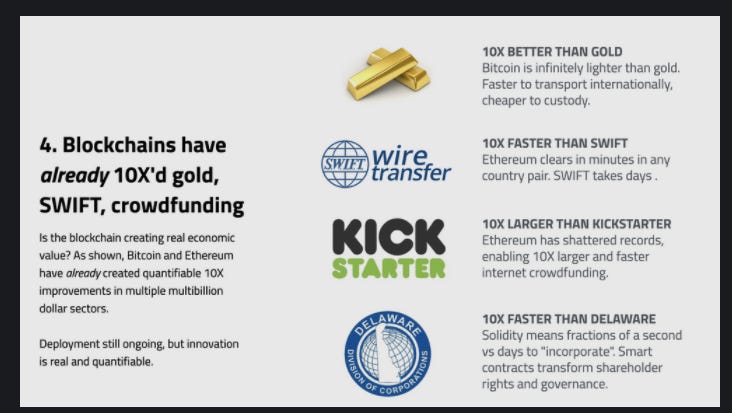
Fast & efficient: Blockchain technology could also reduce settlement times and eliminate error handling by providing real time tracking of transactions without double spending issues. Instant payouts both within and cross border transfers. Crypto in general is good for payments that are very large, very small, very fast, very automated, very international, and/or very transparent relative to the traditional financial system. For example, you can use a stablecoin to programmatically split $100,000 among 1000 different people in 50 different countries to pay each $10 for a microtask, give them a transaction confirmation almost immediately on the Ethereum blockchain, and fully settle the monies within a few minutes such that all 1000 recipients can spend their earnings. You can raise 30 million dollars in 30 seconds on-chain. You can even stream money in realtime, rather than making people wait 2-4 weeks between paychecks. These kinds of feats represent >10X improvements on basic financial primitives and are simply impossible with the old banking system. So crypto has boosted the performance of global finance on many dimensions.
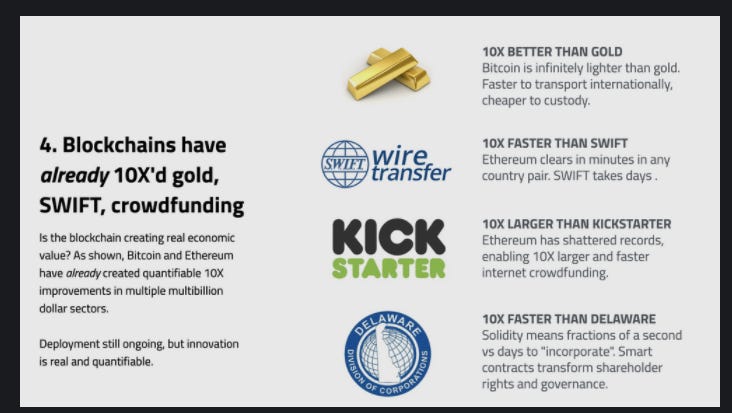
Image source: link
Smart contracts: Most importantly, blockchain reinforces trust among the two participating parties (trustless arrangements via smart contracts and not dependent on any indidvidual/ organisation)
Access to both domestic & foreign funds: a small business owner can now use his phone to make not just domestic phone calls, but international ones. So shouldn’t he be able to receive funds from around the world as easily as he can now within his country? Adopting crypto will also help developing countries to get access to foreign funds without dependence on either American or Chinese corporations.
The space is growing so fast that it’s impossible to summarize everything that's happening.
Few references to track:
Defipulse.com- to view all the protocols,
Coinmarketcap.com- to look at the valuations of their underlying tokens, and
coindesk.com for discussion on these protocols
The main point, though, is that defi is to finance what the internet was to information. Just like the internet gave the average Indian access to millions of new sources of information, decentralized finance has the potential to give every Indian direct access to millions of new sources of capital.
Now, you will ask, major currencies like bitcoin & ETH are highly volatile, how can anyone transact in these currencies. But, what if there was a way you could buy a cryptocurrency that was basically cash meaning it didn't change value but it was still transferable and tradable as a crypto.
If you are well versed with crypto benefits, have deep knowledge of stable coins, you can directly jump to Recommended Model section.
Introducing stablecoin:
Stablecoins are digital assets that are designed to maintain a stable value relative to a national currency or other reference assets. A stablecoin is technically a utility token built upon another coin's blockchain. The entire goal of a stablecoin is to create a cryptocurrency that isn't volatile and doesn't change price. Stablecoins offer convenience, privacy and security of crypto while offering the stability and trust of fiat currency (like USD, EURO). A stable coin is pegged to the US dollar and should always equal one dollar.
Theoretically bitcoin, the first cryptocurrency, was actually created to be used as a store of value, however, due to its price fluctuation, it is classified as a speculative investment. So what if you want to store money using crypto technology but you don't want to risk your investment with the price fluctuations of crypto in today's world? Well you can use a trusted stablecoin.
Stablecoins can be used to buy a coffee, house, cross border transfers by using simple computer or mobile phone. It can also serve as a store of value against local inflation and their country’s currency devaluation. In this way, crypto can serve as an informal banking infrastructure of its own, beyond being used simply as a remittance system. The total supply of stablecoins has increased from $20B to more than $135B over the past year. Naturally, this staggering growth has prompted interest from lawmakers and regulators.
Using stable coins you can trade back and forth from ethereum to a stablecoin and from that stablecoin to bitcoin, from that bitcoin back to another stablecoin whenever you want using a decentralized exchange (exchanges run by a code that cant be regulated by government ; coinbase is a centralised exchange run by an incorporated company and can be regulated by government). This way you don't have to pay as many fees or wait as long or you don't have to worry about the government tracking or canceling your transactions as you would have to do if you used a centralized exchange. Now this is actually a really good advantage of stable coins.
How do stable coins work:
Collateralized stable coins
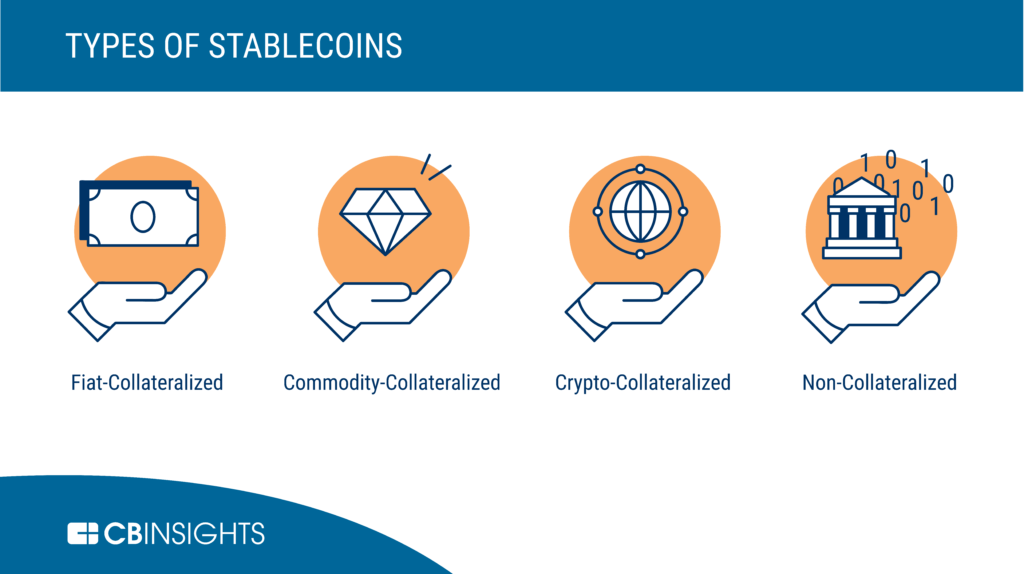
Fiat Collateralization: This is perhaps the easiest to implement and functions like a basic IOU system. Each and every token is collateralized by an equal amount of fiat currency held by a central custodian (such as a bank). Holders are guaranteed to redeem their token at any point for the stable value denominated in fiat, say $1.
Tether is perhaps the most famous example. For every issued Tether token (USDT), an equal amount of US dollars is deposited with a custodian, meaning Tether should always trade 1:1 (1USDT = 1USD). Despite the stable value, Tether has come under a lot of scrutiny. Many believe the token is not sufficiently collateralized and its issuance of hundreds of millions of new tokens without having its reserves being officially audited is only casting more doubt on the token’s validity.
Commodity collateralization: A similar concept but backed by a different asset is Digix. In an effort to create a stable coin, the token is collateralized by gold. Every DGX token is equal to 1 gram of 99.99% LBMA approved gold. It’s therefore stable in respect to 1 gram of gold, but as the value of gold can still fluctuate, the price of token with respect to USD or any other fiat currency is not necessarily stable.
Although fiat collateralized tokens (or commodity backed tokens for that matter) do bring a degree of stability, it’s unlikely to become an everyday token of choice for two main reasons.
One, it’s not scalable – you will need huge amounts of capital to serve as collateral if you want to mint enough tokens to have the ability of mass adoption. And two, a central authority or custodian will have to be trusted with keeping the collateral (e.g. banks). This is counterintuitive as the possibility of a central influence is exactly what cryptocurrencies want to safeguard against.
Crypto collateralization: The first cryptocurrency to use this form of collateralization was BitShares, which uses their native network currency (bitshares) as collateral to create market pegged assets such as BitUSD, BitCNY and BitGold. These market pegged assets can then be traded like futures (derivative contracts) to effectively increase the collateral.
Another coin that uses this mechanism is Dai, developed by MakerDAO. Dai is pegged to USD but collateralized by Ethereum. A Dai user could therefore generate the stable coin by locking up an excess amount of ETH in a smart contract. Smart contracts are completely autonomous and trustless environments which mean if the user wants to access their collateral, they simply have to pay back the Dai debt (no reliance on third-party institutions). Alternatively, the reserves will be sold automatically if the collateral dips below a specified threshold.
Crypto collateralized stable coins are more decentralized and more liquid than their fiat collateralized counterparts, but again, unlikely to work as a stable, everyday token.
The reliance on a cryptocurrency as collateral makes them less stable and also requires over-collateralization (read huge amounts of capital) to absorb inevitable price fluctuations. But maybe more importantly, they rely on very complex mechanisms to ensure stability which is likely to scare off many potential users.
Algorithmic Mechanism:
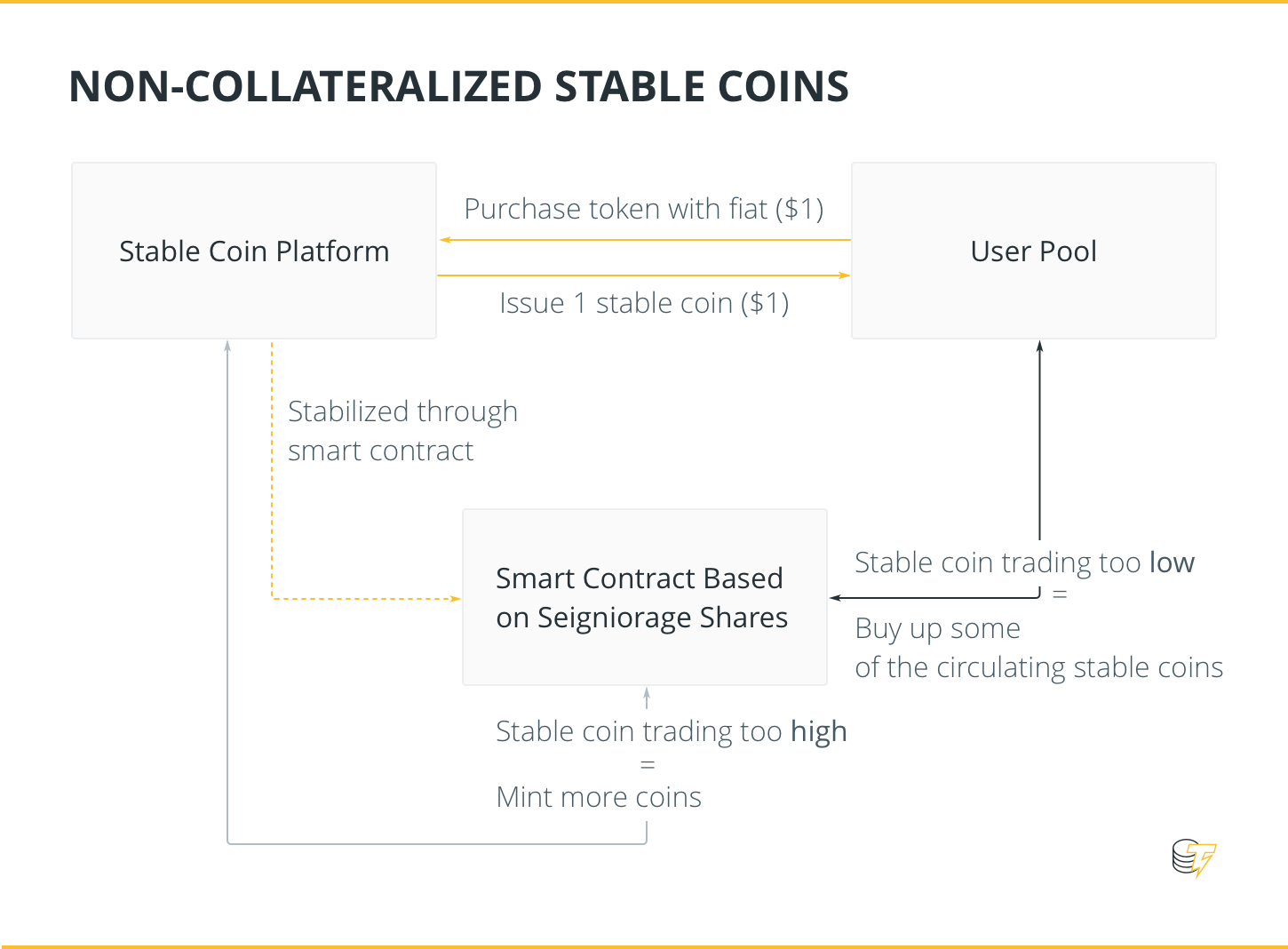
Image source: Internet
Algorithm based non-collateralized stable coins aim to closely mimic fiat currencies by not having any asset-backed collateral. Instead, price stability is achieved through an approach called seigniorage shares, a processed that was conceived by Robert Sams, founder and CEO of Clearmatics Technologies LTD.
Through this approach, smart contracts can be programmed to resemble a reserve bank, enabling it to increase and decrease the supply of money in order for the value to remain as close as possible to the value of a pegged asset, such as USD.
It works on a foundational economic principle called supply and demand. If the coin is trading too high, the smart contract will mint more tokens to increase supply and therefore reduce the value of the coin.
The excess profits now lying in the smart contract is called the seigniorage. If the coins are trading below its market pegged asset, it will buy up some of the circulating supply with the excess profits, therefore decreasing supply and increasing the value through excess demand.
But if the seigniorage is too low to buy enough tokens to increase the value to an adequate level, shares can be issued which gives the holder rights to future seigniorage (excess profits in the smart contract). Excess profits will be distributed between investors of the platform.
The biggest problem here is that if the token platform does not continue growing with new users, it will be impossible to maintain its market peg. There’s also only a specific limit of downward pressure such a system can take before investors lose faith in the coin’s ability to pay out future seigniorage shares.
There are a number of stable coins using this concept with the most noteworthy being Basis (formerly known as Basecoin) and Saga.
Basis will peg to the US dollar in the short term but eventually aims to peg to a consumer price index (CPI) as holders use the coin to purchase goods and services.
Terra with combination of its native token Luna is widely used for day-to-day payments in South Korea. It has more than 30 million users with more than a billion dollar in payments.
Non-collateralized stable coins will be the most viable option as an “everyday-token”, purely because it mimics the stability mechanisms used by traditional reserve banks with fiat currencies, while still staying completely decentralized and independent.
It’s not perfect though as it requires continual growth from the platform for the stability mechanisms to work. This, in turn, makes it particularly vulnerable to a crash in the overall market or decline in interest from investors. Achieving stability can also be a complex process and safety parameters for upward and downward pressure is difficult to determine with reasonable certainty.
Leading Stablecoins:
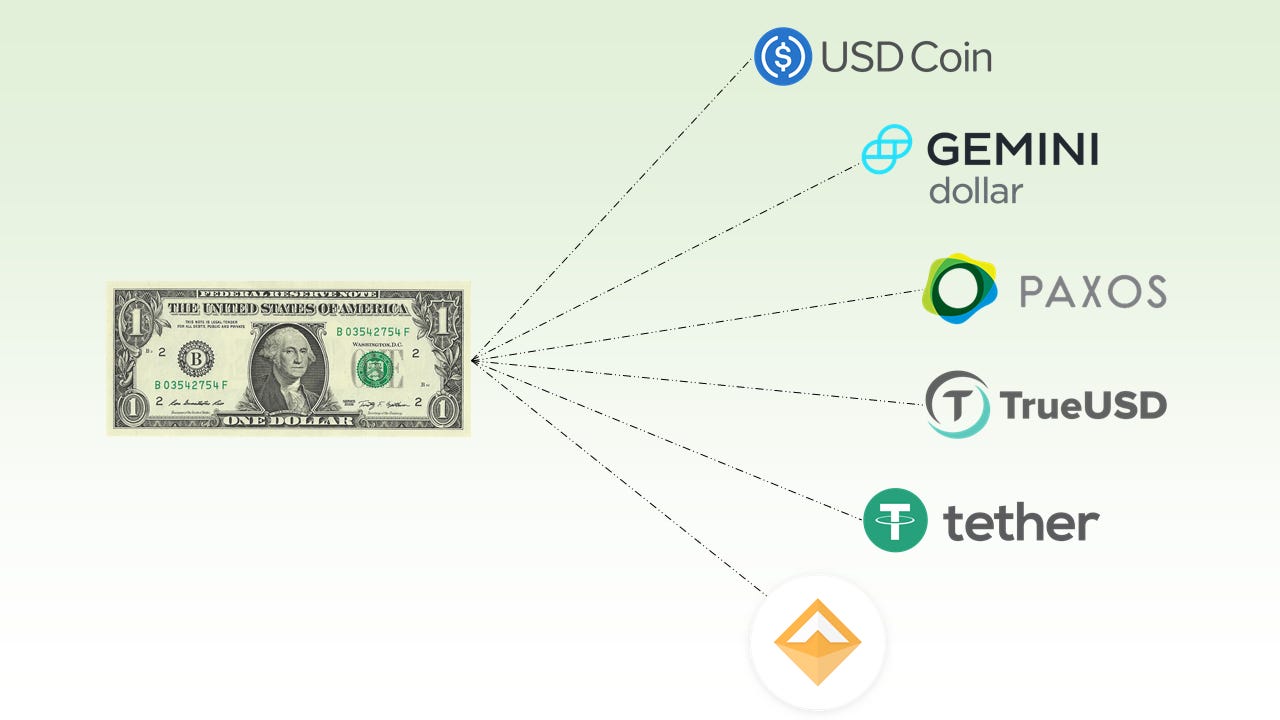
Tether (“USDT”), a stablecoin issued by Tether Limited, is said to be the most popular stablecoin. USDT was originally designed such that each coin would be worth $1.00 USD and it can be traded on more than sixty exchanges with 400+ trading pairs. As an early market player, USDT is supported by numerous blockchain applications and payment methods, but the pervasiveness of the token may change as other more trustworthy stablecoins gain market acceptance.
USD Coin (“USDC”) is a USD-backed stablecoin powered by CENTRE, an open-source technology and protocol development project initially supported by Circle and Coinbase. USDC is compatible with Ethereum wallets such as Coinbase Wallet. CENTRE promotes its compatibility and usability as value propositions, leaning on Coinbase’s strong reputation.
Paxos Standard Token (“PAX”) is a stablecoin issued by Paxos, a chartered trust company supervised by NYDFS. Paxos also offers regulated services related to crypto assets. Like other stablecoins, Paxos promotes its stability and versatility. Some of its marketing focuses on peer-to-peer transactions and users can focus on its applications for trading, commerce, and peer-to-peer transactions while instantly sending and receiving US Dollars around the world.
DAI is a decentralized stablecoin running on Ethereum that attempts to maintain a value of $1.00 USD. Unlike other centralized stablecoins introduced above, DAI is backed by collateral on the Maker platform instead of is not backed by US dollars in a bank account. The system employs smart contracts on Ethereum through the use of Collateralized Debt Positions (CDPs) and autonomous feedback mechanisms to actively stabilize DAI’s exchange rate.
QCAD is a new regulated Canadian dollar-pegged stablecoin launched by Canada Stablecorp. Stablecorp assured that the underlying assets are held with an independent custodian and their policies and systems are designed fully compliant with FINTRAC requirements for Money Service Businesses in Canada.
Decentralized and public blockchains will always provide a framework to enable financial inclusion but traditional actors from the financial system will also participate in the process, as there are clear incentives. According to a report from the World Bank, USD 380 billions could become the estimated revenue generated by banks by 2020 within emerging markets from unbanked population. Moreover, the report mentions that blockchain technology could reduce banks’ infrastructure costs attributable to cross-border payments, securities trading and regulatory compliance in the range of USD 15 to 20 billions per year by 2022. If we add to the equation the fact that (according to the report) mobile penetration even in low-income countries is over 50%, mobile apps interacting directly with blockchain technology could generate a massive influx of new customers.
Katie Haun from a16z has covered beautifully on principles for stablecoin regulation- built into Equitable access to all, Ensuring integrity of stablecoin issuers and reserves, and Strengthening Technological & Operational Resilience.
However, Web 3.0 come with their own challenges for financial inclusion:
Security & Privacy for Identities: Regardless of the usage of public or permissioned blockchains, data security will be of paramount importance and is a topic that is widely investigated by blockchain experts.
Regulatory Status: Government regulation will be required for traditional actors to become interested on playing the game. Non-traditional actors will always represent an interesting option for anyone interested on exploring blockchain technology but some portion of the unbanked population would prefer support from traditional financial actors.
Widespread Adoption: Blockchain technology will require users and companies to adapt to a new technology on which the learning curve may be slow for new-comers both from the private and public sector.
Initial Costs: As we have analyzed above, blockchain technology could generate a big influx of new income but high implementation costs could considerably slow down the process for commercial banks. However, decentralized and public options will always be available for the unbanked.
Recommended model for Financial Inclusion: Use CBDC to facilitate domestic commerce & crypto protocols to attract international investment
We discussed the benefits of introducing stable coins (faster, cheaper, transparent, and available to all). But to make stable coins mainstream, we need to ensure mass adoption, verified identities and degree of control incase of emergencies (as explained above).
An optimal model could be that countries launch their own stable digital currency (also known as Central Bank Digital Currency or CBDC) issued by and backed by a central bank, so the adoption within a country may be far wider. The central bank can still intervene to freeze funds or reverse transactions for a national digital currency under unusual circumstances, but most other uses would be cash-like and not interfered with. CBDC is not just viewing balance or transacting through bank accounts. It means any user can transact in that currency from any platform to any platform without any intermediary involvement in a decentralised manner. CBDC would give everyone the ability to hold and send money without a bank in the middle, just like email gave everyone the ability to store and send mail without a post office in the middle.
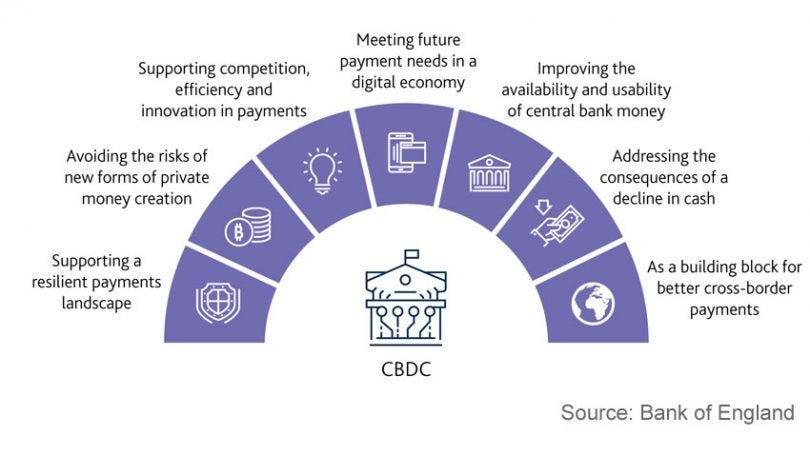
These CBDC (or stable currency launched by Central Bank) will be clubbed with crypto wallet for international exposure. Put another way, by adding both digital currency and cryptocurrency support, any developing country would (a) run a permissioned ledger for domestic transactions via the CBDC and (b) use decentralized ledgers for international affairs (not controlled by any other country at either the currency or platform levels.)
Clubbing both CBDC and crypto will also help in accessing the national stacks for KYC and keep currency stable. For example, India has UPI, Russia has the Yandex search engine, and South Korea has the Naver portal and shopping service; these give partial domestic alternatives to PayPal, Google, and Amazon respectively.
Both blockchain and cryptocurrency need to stay- its not either/ or.
Movements on CBDC globally:
China appears to be leading the global race to launch a digital currency, having distributed 10 million digital yuan to Shenzhen citizens a year ago. China’s CBDC has been used to conduct 62 billion yuan ($9.7 billion) of transactions as of the end of October, an official from the People’s Bank of China said.
Central Bank of Nigeria has launched eNaira (CBDC) in October
Indian Central Bank (Reserve Bank of India) may pilot CBDC in 2022
Peru is planing to launch CBDC soon and in talks with other banks for partnering
Lets explore some use cases that can help in achieving financial inclusion from an individual, MSME, and startup’s point of view:
Use case 1: Access to global capital for lending and crowdfunding by small or new businesses:
MSMEs need access to cheap capital without any physical collateral. Without this money, they get lack of growth, unregulated capital markets, loan sharks, high interest rates, and constant state intervention to prop up failing enterprises.
Total value locked in De-fi has crossed $120B from $1.5B in two years. No doubt, we see a trillion dollar in de-fi in few years.
Crypto-backed lending allows consumers to access loans denominated in fiat currency or another crypto asset through peer-to-peer transactions with no financial institution involved. DeFi lending projects come in different categories, exhibiting varying degrees of decentralization. On one side of the spectrum are custodian-based platforms such as Celsius and BlockFi. These projects maintain a certain degree of centralized influence over their ecosystems — implementing Know-Your-Customer (KYC) protocols, acting as custodians of financial assets, and facilitating interactions between their platforms’ users. On the other side of the spectrum are self-custodied platforms such as Compound and Aave. These projects use automated protocols to facilitate essentially every element of the loan, from collateral to interest — entirely accessible to practically anyone at any time, without taking custody of users’ funds or requiring KYC procedures.
Crowdfunding is another way to raise capital. In 2015, the top online crowdfunding projects raised tens of millions; by 2017 they were able to raise billions, a 100X improvement in a matter of two years. As a concrete example, Indian developers who built an Ethereum scaling service called Polygon were able to attract crypto capital from around the world, turning them into India’s first crypto protocol valued over $1B.
Use case 2: Emerging creator/ entrepreneur/ student can issue personal token:
Former Coinbase employee Reuben Bramanathan launched a personal token that buyers could redeem for an hour of his time. Crypto entrepreneur Alex Masmej sold $20k worth of personal tokens to investors to redeem for the lesser of 15% of his future income or $100k over the next three years. Investors who buy and hold these personal tokens are essentially betting that an hour of a promising person's time or investing in future of an emerging individual might someday become more valuable. Launching CBDC on crypto can help to mint personal tokens where money can be raised both domestically and internationally.
Use Case 3: Remittance to home country (for migrant workers) or salary from international employers (remote work)
Faster remittance without any transaction charges and no paperwork. No dependence on platforms like Paypal and avoid international foreign currency fluctuations.
Summary points:
Crypto for financial inculsion is what internet was for information. As internet gave access to all to all information; crypto will give access to anyone with access to financial inclusion- faster & cheaper remittances, no lengthy paperwork or identity checks, access to global capital, no intermediary fees, trustless guarantees and so on.
Stablecoin - it is a currency pegged with blockchain-hosted digital assets, pegged 1:1 to a national currency, with 100% of value backed by fiat currency. Stablecoins can be collateralized (against fiat currency, gold or crypto currnecy) or these can be algorithmic based stablecoins (working on demand-supply mechanism). Stablecoins can help in cross border settlements immediately without worrying about foreign currency fluctuations
For stablecoins to be successful, they need to move to scale, heavy adoption, identity protection and bearing of initial costs
CBDC (Central Bank Digital Currency)- digital currency issued by the central bank that can be transferred from one platform to any other platform globally (without any intermediary involvement) in a decentralised manner. This currency can be downloaded (just like you can withdraw money from ATM).
Recommended model- Club CBDC with crypto network. This gives benefits of decentralization clubbed with national stacks of countries.
From above model, an individual can launch his own tokens, MSMEs can have access to global capital (without extensive documentation), crowdfunding and so on.
Countries like China, Nigeria, Peru have already started their work on CBDC.
Thank You!